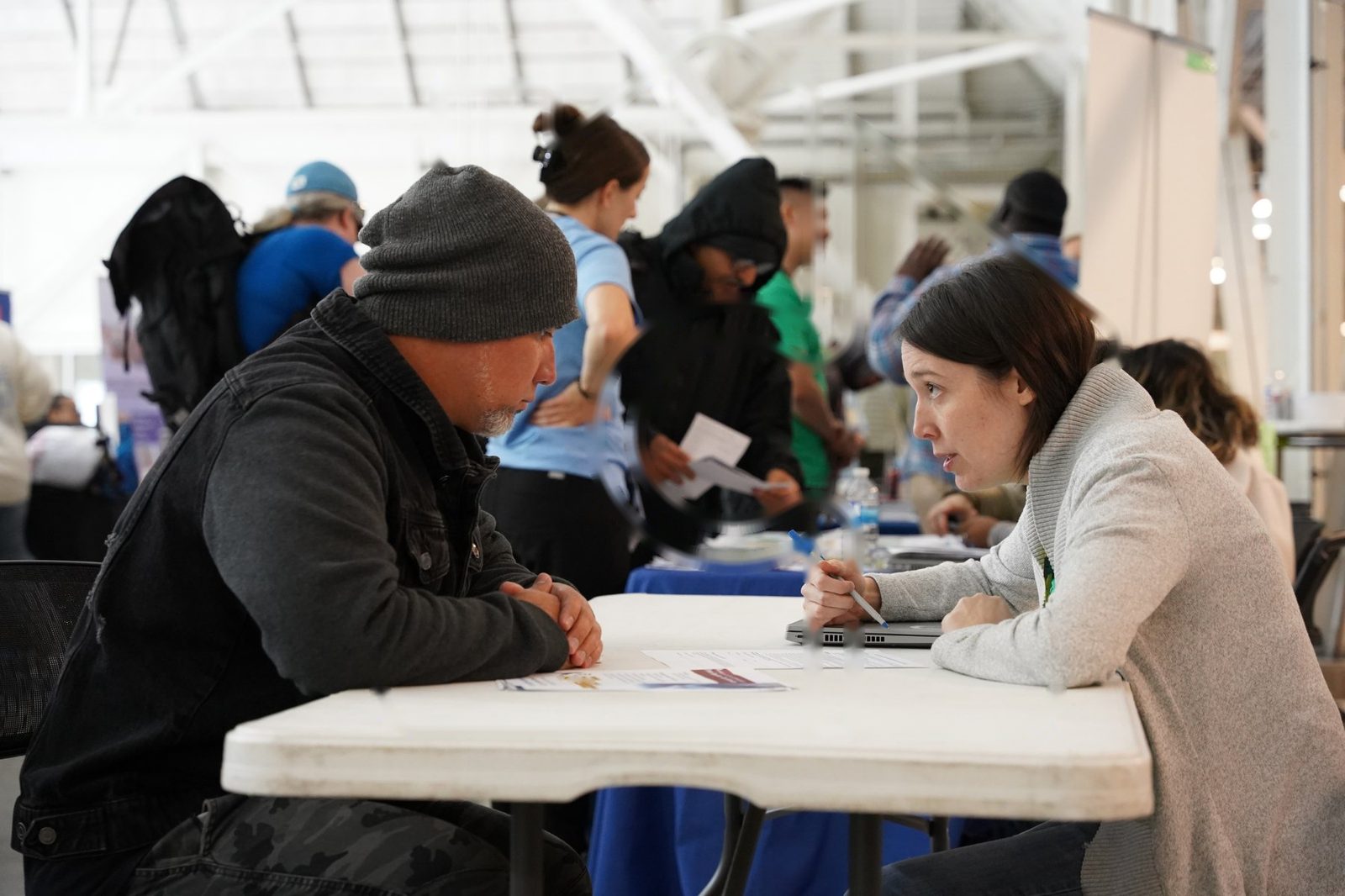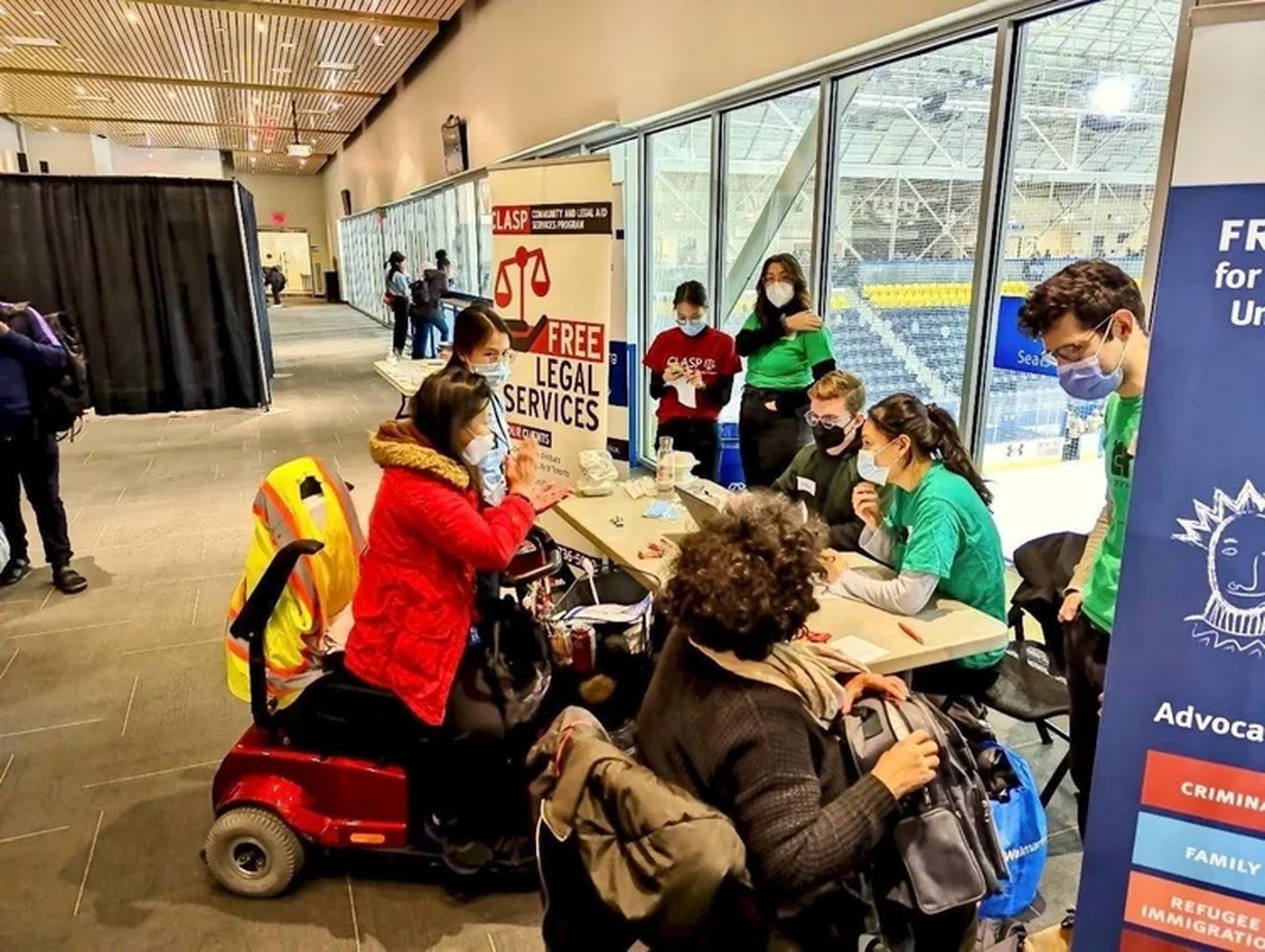
“You’ve helped me feel validated as a human being with respect and support.”
— From a participant at a Homeless Connect Toronto event
That connection is what frontline workers are here for. Everything else — the searching, the databases, the paperwork — is friction. We’re here to reduce it.
AI-powered resource discovery. Free. For everyone who serves.
Ontario alone has 60,000 community programs and services in databases like 211 - systems that don't understand your context and don't remember your last search.
We know that broken search isn't the hardest part of frontline work. But it's a part we can do something about.
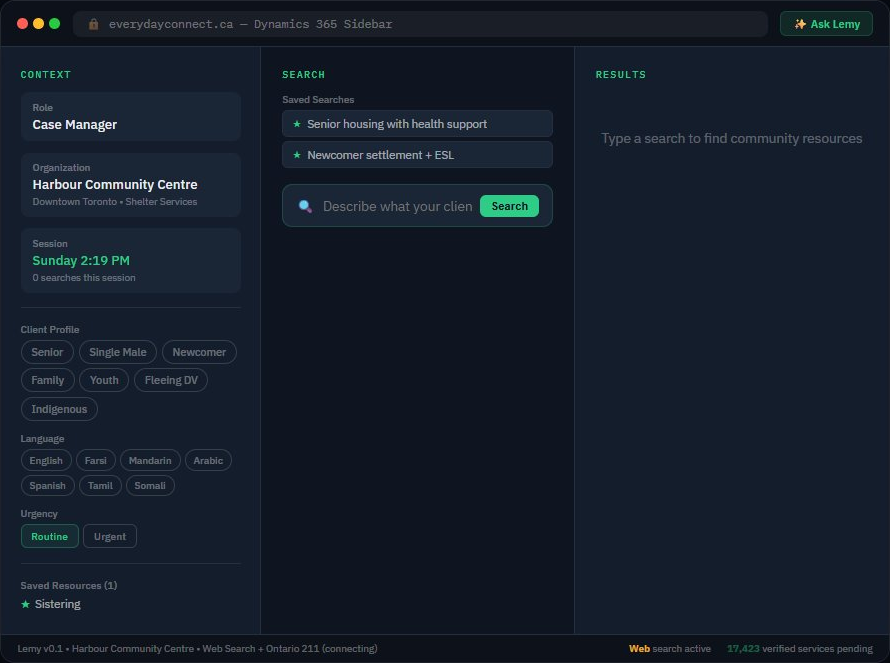
That's what Lemy is for. Lemy is an AI-powered resource discovery widget that embeds inside the tools frontline workers already use. One search bar. Natural language. Results in seconds. No new system to learn.
It does two things that nothing else in this space does:
Lemy understands natural language, context, and the relationships between services, people, and needs ("Mandarin-speaking walk-in support for a senior veteran") returns relevant matches even if no database has that combination of filters.
Experienced frontline workers carry knowledge no database holds. When those workers leave, everything they know leaves with them. Lemy captures that knowledge as a byproduct of daily work - one-tap signals, AI-generated annotations and anonymized referral signals from case management systems. Individual expertise becomes organizational memory.
Every search, every referral, every annotation generates data the sector has not had - what communities need, where the gaps are, which services actually deliver - with no extra data entry. The intelligence is a byproduct of the work.
nuAmple believes the people doing the hardest work in our communities deserve more than what the sector has been able to give them.
Six organizations contributing time, infrastructure, and expertise to build Lemy as public infrastructure.


Lemy (Let me... help you) is a portable AI widget for any website, portal, or case management system. Workers click "Ask Lemy," describe what they need in plain language, and get relevant results immediately. Context retained across queries - no starting over.

211 has the most useful information — eligibility, intake procedures, languages, practical notes — buried in unstructured text. Lemy understands intent through context and meaning, not keywords.
Workers contribute lore through the lightest possible friction: one-tap referral signals, AI-generated annotation options they confirm with a tap, and free-text notes when they choose. The system also captures anonymized referral patterns from case management systems.
One frontline worker told us: "Workers don't so much keep lists of services. They keep lists of people who respond." Lemy makes that knowledge shareable. Individual expertise becomes organizational memory.
Searches, referrals, and annotations generate data as a byproduct of the workflow. No extra data entry. Over time: what communities need, where the gaps are, which referrals connect.
For the PoC, Lemy deploys inside Everyday Connect, Homeless Connect Toronto's resource portal — 13 years of community credibility, an established user base across the GTA.
For HCT and its partners, the immediate result is a more capable Everyday Connect — 60,000+ more listings, with knowledge capture and activity tracking that EC has never had.
Lemy is portable. What we prove inside EC can go anywhere.
The proof of concept validates the foundation — semantic search and lore capture with real frontline workers. What comes next builds on that foundation.
Introduces GenUI, adapting to each worker's context, role, and search history. Evolves from static search into a dynamic learning tool.
An anonymized referral signal from internal case management notes will reveal patterns of service usage and gaps - valuable data previously unseen.
Building on Phase 2, Lemy will aggregate referral data across organizations to create a living map of community needs and service ecosystems.
This gives funders, planners, and policymakers actionable data, moving beyond guesswork to inform strategic decisions that address societal challenges.
Frontline workers hold communities together, sitting with people during some of the hardest moments in their lives. They listen, search for help, make referrals they hope will land. Nobody captures what they know. When they leave, it leaves with them.
The systems they depend on weren't built for them. Every minute lost to a broken system is a minute not connected with the person in front of them.
We don't claim to solve homelessness. We claim to make the people trying to solve it more effective at their work. Every city has frontline workers navigating fragmented systems. Most have 211. If this works in Toronto, the model is portable.
These three tracks serve a single purpose. When search works, when knowledge is captured, when patterns are visible — workers have time for the part of the job that actually matters.
Time enough to listen — which is what the person across the table will remember.
For workers
Reduced administrative friction. Less time navigating broken systems means more capacity for the human work they came to do. Not a cure for burnout — but one less thing adding to it.
For the people they serve
A worker who has time to listen, who knows where to send you, and whose referral carries weight because a real person made it. That’s what dignity in a moment of crisis looks like.
We can’t create housing or meals. We can make sure the systems aren’t standing between a worker and the person who needs them.
We work with communities, not for them. Every partnership starts with listening.
Technology is the tool. The person across the table is the point.
The workers doing the hardest work have the least access to good technology. We're here to change that.
Frontline workers shape what we make. If it doesn't work in their hands, it doesn't work.
Deploy with real workers. Measure what happens. Publish findings.
Contingent on PoC results. Adaptive interfaces, case management integration, org adoption beyond the pilot.
Community intelligence. Referral patterns available to funders and planners. Earned revenue sustains the free frontline tool.
We publish regardless of outcome.
Better technology won't solve homelessness. But it can make sure that when someone asks for help, the person they've reached has the time to listen.
$1,000 funds a week of frontline research. $50,000 funds the proof of concept. Every contribution moves this forward.
Support This Work Start a ConversationIf any of this is relevant to your work, we'd welcome hearing from you.
Or email directly: john@nuample.org
US 501(c)(3) | Ontario Not-for-Profit